

Summer is traditionally associated with effortless beauty, sunlit skin, windswept waves and the illusion of naturally perfect holiday hair. Yet behind this idyllic image lies a far less glamorous truth. For the hair fibre, summer is one of the harshest and most destabilising periods of the entire year. Long days under ultraviolet radiation, repeated contact with chlorinated pools, sea salt, dry air, humidity, increased perspiration and more frequent washing create a cumulative form of stress that gradually alters the hair’s internal structure.
Hair may appear lifeless by the middle of the season not because it has suddenly become “difficult”, but because its biological and chemical balance has been steadily compromised. According to guidance published by the American Academy of Dermatology, ultraviolet radiation does not affect only the skin. It also degrades the proteins that maintain hair strength and elasticity, particularly keratin, while simultaneously reducing the moisture content that gives strands flexibility and sheen.
The visible consequences are familiar to almost every woman by late July. Hair begins to feel rougher under the fingers, styling no longer holds with the same elegance, ends become drier, and the once luminous surface gradually loses its reflective gloss. Coloured and lightened hair suffers even more dramatically because ultraviolet rays accelerate oxidation of artificial pigment and strip away tonal depth, leaving colour looking flat, brassy or prematurely faded. This is precisely why salon-fresh blonde, caramel or chestnut shades often lose their expensive richness after only a few weeks of summer exposure.
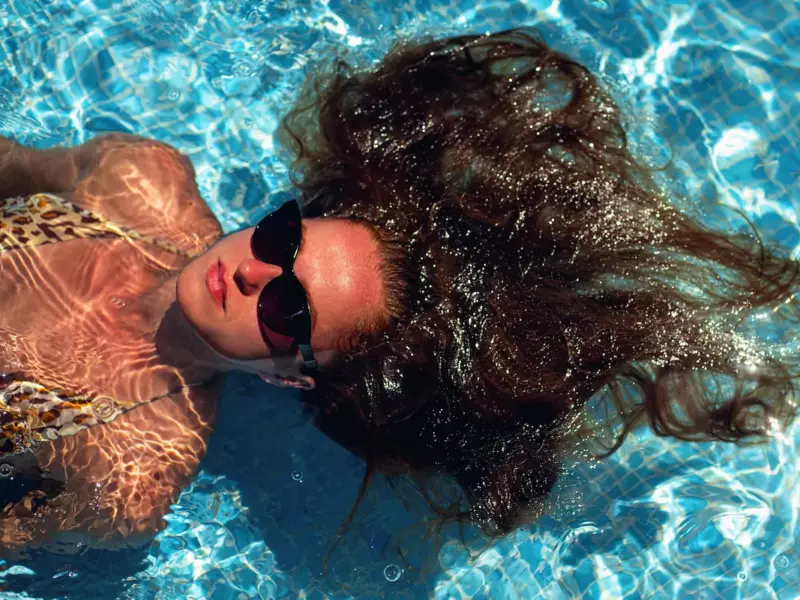
Chlorine introduces an entirely different level of damage. Swimming pool water lifts the cuticle and penetrates porous sections of the strand, disturbing the outer protective barrier that keeps moisture inside. Hair that has been bleached, highlighted, chemically straightened or frequently heat styled is particularly absorbent and therefore particularly vulnerable. It does not simply come into contact with chlorine; it drinks it in.
Sea water appears gentler, but physiologically it creates another problem. Salt draws moisture outward, encouraging dehydration and leaving the hair fibre swollen, coarse and more prone to tangling. The result is the notorious combination many women experience after beach holidays: frizz at the crown, dryness through the lengths and fragile ends that suddenly seem impossible to smooth. Summer therefore is not a neutral aesthetic season for hair. It is a season of structural depletion, and understanding this is the first step toward preserving its beauty.
The core principle is protection before exposure rather than restoration afterwards
One of the most common mistakes in seasonal beauty care is the assumption that hair can simply be repaired at the end of the day. Women invest in masks, serums and salon rituals after returning from the beach, yet often ignore the far more strategic phase that comes before contact with the sun and water. In reality, preventative protection is dramatically more effective than emergency restoration.
Think of summer hair care not as cosmetic rescue, but as luxury preservation. The goal is to reduce the amount of stress the hair absorbs in the first place.
One of the most underrated techniques recommended by beauty editors at Allure and supported by trichologists is the application of oil before swimming. Coconut oil, jojoba oil or lightweight botanical oils applied to damp lengths create a semi-occlusive layer that slows the penetration of chlorinated or salty water into the shaft. Coconut oil is especially valued because its molecular composition allows it to move beyond the outer layer and reduce protein loss within the cortex itself.
An equally intelligent but often overlooked ritual is wetting the hair with clean fresh water before entering a pool. Hair behaves like a sponge. If it is already saturated with non-chlorinated water, it physically absorbs less chemically treated pool water afterwards. This simple preparatory step requires less than a minute and yet can make a substantial difference over the course of a holiday.
Hair SPF has also become one of the most sophisticated innovations in modern warm-weather beauty. Once considered unnecessary, ultraviolet protective sprays and leave-in mists are now increasingly recognised by editors at Vogue as an essential category for preserving colour and preventing roughness caused by solar exposure. These products create an invisible shield over the cuticle, reducing dryness, oxidation and surface dullness.
And then there is the oldest, simplest and still one of the most effective protective tools of all: physical coverage. A silk scarf, a linen hat, a wide-brimmed beach cap or even a loose braid tucked under fabric can dramatically reduce direct ultraviolet assault. In expensive beauty, elegance and practicality often meet in the same gesture.
The summer moisture routine that actually delivers results
Once summer begins, the standard hair routine that worked beautifully in spring often becomes insufficient. Heat increases evaporation. Air conditioning dries the environment. Salt and chlorine repeatedly open the cuticle. Frequent showers remove protective oils. The hair therefore loses hydration faster than most women realise, and the routine must evolve accordingly.
The foundation begins with cleansing. Summer is not the ideal season for aggressive clarifying shampoos used several times a week. Hair that is already exposed to environmental depletion needs cleansers that remove residue without stripping the fibre entirely. Sulphate free or low sulphate hydrating shampoos paired with moisture rich conditioners become less of an indulgence and more of a necessity.
Conditioner during summer should never be treated as optional, even for fine hair textures. Lightweight formulas can be chosen, but omission is where many seasonal problems begin. Conditioner restores slip, softens the cuticle and reduces the friction that leads to breakage during brushing.
A weekly deep conditioning treatment is where the real replenishment happens. A nourishing mask left on for ten to twenty minutes, ideally under a warm towel, allows humectants, lipids and softening agents to penetrate more effectively. Hair that is coloured, naturally textured, bleached or frequently exposed to sun often requires this ritual not occasionally but consistently.
Leave in conditioner becomes one of the true heroes of summer because it functions throughout the day rather than only in the shower. It offers continuous softness, improved manageability and a light protective film against external dryness. This is particularly beneficial during travel, beach days and city heatwaves when hair remains exposed for long periods.
As a finishing touch, argan oil or serum based botanical blends help seal moisture into damp strands. They do not replace hydration, but they prevent freshly added moisture from escaping too quickly. This final layer is what often determines whether hair dries into polished softness or into an unruly cloud of dehydration.
Immediate care after the sea or pool makes a visible difference
The period immediately after leaving the water is far more critical than many people imagine. Chlorine and sea salt do not stop affecting the hair the moment swimming ends. They remain on the surface and continue drawing out moisture or disturbing the cuticle until they are thoroughly removed.
This is why immediate rinsing with fresh water is arguably the single most effective post swim habit a woman can adopt. Even a quick beach shower significantly reduces the amount of residual salt and chemical build-up sitting on the fibre.
The second rule is mechanical gentleness. Wet hair is in its most vulnerable state because the cuticle is lifted and elasticity is temporarily altered. Rubbing aggressively with a rough towel creates friction that translates directly into frizz, snapping and surface damage. Instead, the hair should be softly pressed and blotted. Microfibre towels or soft cotton wraps are ideal because they absorb excess water without roughening the strand.
Detangling should also become a slower and more deliberate process. Starting from the ends and moving upward with a wide tooth comb prevents the forceful pulling that often causes invisible but cumulative breakage.
Once every one to two weeks, a deeper cleansing wash with a mild clarifying shampoo helps remove mineral residue from chlorine and sea deposits. This is especially important for blondes and highlighted brunettes, as mineral accumulation can distort tone and leave the hair looking dull, yellowish or slightly green.

Heat styling in summer and how to minimise additional damage
Hair in summer is already under continuous thermal pressure simply from sun exposure and ambient temperature. Adding daily blow drying, curling irons and straighteners on top of this can quickly push it from seasonal dryness into genuine breakage.
For this reason, air drying becomes less a casual preference and more a strategic beauty decision. With the help of a styling cream, mousse or anti frizz leave in product, hair can often dry with far more natural elegance than expected when not repeatedly stressed by concentrated heat.
When a hairdryer or styling tool is necessary, thermal protectant should be treated as a mandatory preparatory layer. It creates a barrier that helps reduce direct temperature assault on the cuticle and lowers the rate at which moisture escapes during styling.
Summer is also the perfect season to embrace no heat shaping techniques that look polished rather than lazy. Loose braids, silk wrapped buns, overnight twists and softly pinned updos not only create texture and movement but shield the lengths from constant environmental abrasion. Sometimes the healthiest hair choices are also the most visually refined.
Scalp care is the often forgotten part of summer hair health
Beautiful hair begins at the scalp, yet this area is frequently ignored in seasonal routines. During hot months the scalp deals with perspiration, sunscreen transfer, increased sebum, dust, salt, product residue and more frequent touching or tying of the hair. When neglected, this environment can quickly become imbalanced.
The instinct to wash every day may feel logical, but excessive cleansing can strip the scalp’s own protective oils and stimulate compensatory oil production. The better strategy is balanced washing according to genuine need, supported when necessary by a quality dry shampoo to absorb surface oil between full cleanses.
Gentle scalp massage several times a week is another deeply beneficial habit. It stimulates circulation, encourages healthier nourishment of the follicles and helps loosen accumulated residue. More importantly, it restores a sense of scalp comfort during a season when many women unknowingly experience irritation, tightness or heaviness at the roots. Healthy lengths cannot exist for long on an exhausted scalp. Summer care therefore must address both.
Summer hair care requires a quiet but significant shift in mindset. The women whose hair still looks glossy, touchable and expensive by the end of August are rarely those attempting to repair severe damage after every beach day. They are the women who understand the elegance of prevention.
Oil before swimming. Fresh water before chlorine. SPF before prolonged sun. Hydration before brittleness appears. Gentle cleansing before residue hardens into dullness. Protective styling before heat damage accumulates.
When summer hair care becomes proactive rather than reactive, the difference is unmistakable. Hair retains not only softness and shine, but its movement, elasticity and vitality. And that is ultimately what makes it look healthy in the most luxurious sense of the word: not styled into temporary beauty, but preserved in its natural brilliance.
Sources
American Academy of Dermatology — Hair and Scalp Care — aad.org/public/everyday-care/hair-scalp-care