

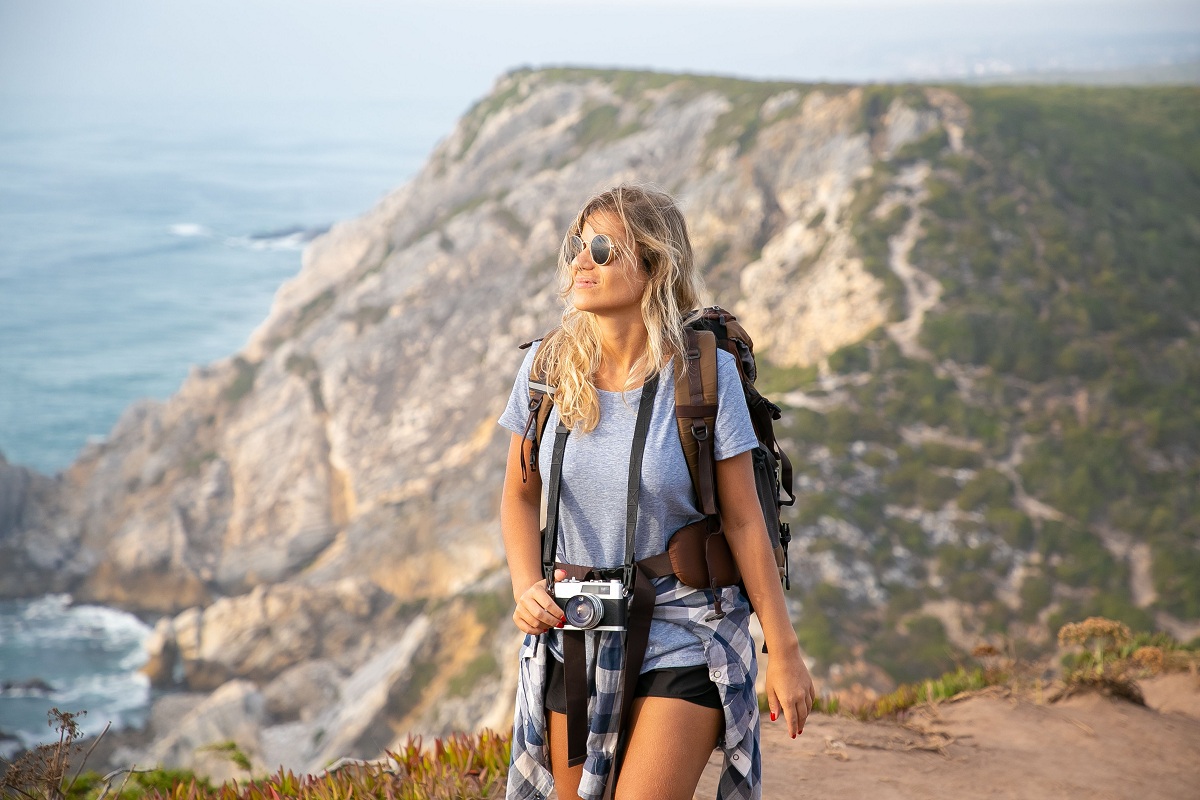
There exists a very particular kind of silence that reveals itself only when a woman finds herself alone in an unfamiliar city, where every sound feels slightly more vivid, every corner seems to hold a story not yet discovered, and every passing face becomes part of a moving mosaic that belongs to no one but still welcomes everyone. In that silence there are no external expectations pressing gently on the shoulders, no shared schedule dictating the rhythm of the day, no compromise shaping each decision about where to go or how long to stay. There is only the quiet intimacy of personal choice, unfolding moment by moment, like a conversation between a woman and her own inner world.
For some, this image feels like liberation, something long desired but not yet claimed. For others, it carries a subtle tension, a feeling of stepping into the unknown without the familiar comfort of companionship. For many women, it is both of these sensations existing at the same time, woven together in a way that is complex, human and deeply honest.
In recent years solo travel for women has entered a remarkable renaissance, not as a fleeting trend but as a meaningful cultural shift that reflects how women are redefining independence and personal space. According to global travel research shared by Booking.com, the number of women choosing to travel alone has increased significantly over the past decade, rising by more than forty per cent. This is not simply a change in travel habits, it is a quiet revolution in perception, where freedom is no longer postponed for the sake of convenience, and personal desire is no longer placed at the bottom of a long list of responsibilities.
The fears that hold women back and what lies beneath them
The first and most deeply rooted fear is the fear of safety. It is a fear that deserves respect rather than dismissal, because it is shaped by lived experience, cultural narratives and practical realities that differ across regions and environments. Women travelling alone do encounter certain risks more acutely than male travellers, yet it is equally important to understand what those risks truly consist of. Studies and travel reports consistently show that most challenges faced by female solo travellers are not extreme dangers but rather situations such as unwanted attention, social discomfort, miscommunication or logistical confusion in unfamiliar surroundings. These experiences, while unsettling, are often manageable with preparation, awareness and informed decision making. Safety, in this context, becomes less about fear and more about knowledge, planning and presence of mind.

The second fear is loneliness, a fear that is often imagined more intensely than it is actually experienced. It manifests in images of sitting alone at a restaurant table, of watching sunsets without someone beside you, of feeling as though solitude might be interpreted by others as isolation or lack of connection. Psychologists often describe this as observer anxiety, a heightened awareness of how one might appear in the eyes of others. Interestingly, this anxiety tends to peak before the journey begins and gradually dissolves once the journey unfolds. Many women who return from solo travel describe an unexpected truth, that they were rarely lonely, and instead experienced a deeper sense of presence, connection and attentiveness to their surroundings.
The third fear is practical in nature. It is the concern of managing everything alone, from transportation and navigation to unexpected disruptions that may arise in a foreign environment. Questions emerge naturally. What happens if something goes wrong. Who assists if plans fall apart. How does one navigate unfamiliar systems without support. These are not irrational fears. They are grounded in real concerns and deserve structured answers rather than motivational slogans. Solo travel becomes far more accessible when approached with preparation rather than assumption.
Why solo travel transforms a woman from within
Psychologists who study human development through travel often describe transformation as a process built on three interconnected experiences.
- The first is the discovery of personal competence. When a woman navigates a new city on her own, finds her way through unfamiliar streets, solves small unexpected problems and makes decisions without external input, she begins to see herself differently. Capable. Adaptable. Resourceful in ways that may not have been fully visible in familiar environments. This is not about becoming someone new, but about recognising strengths that were always present but not fully activated.
- The second experience is the emergence of personal voice. In shared travel, decisions are often shaped by group dynamics. Preferences are adjusted, compromises are made, and personal desires sometimes take a quieter position. In solo travel, every decision becomes an expression of self. Where to walk. What to eat. How long to linger in a museum hall. Whether to wake early or sleep late. These choices may appear small, yet they form a continuous thread of autonomy that strengthens a woman’s connection with her own desires. Over time, this practice becomes a language of self trust.
- The third experience is the encounter with the self in its most unfiltered form. Away from familiar roles, expectations and routines, a woman meets herself without the usual context that defines her daily identity. In this space, thoughts become clearer, emotions feel more direct, and inner reflections surface with a surprising clarity. It is not an escape from life, but rather a different angle from which to see it.
Practical advice for a first solo journey
For those beginning their first experience with solo travel, the choice of destination can shape the emotional tone of the journey. Countries known for safety, infrastructure and accessibility often provide a gentle introduction to independent travel. Iceland, Japan, Portugal, New Zealand and the Scandinavian regions are frequently highlighted by experienced travellers for their reliability and ease of navigation. These destinations allow a woman to focus less on survival logistics and more on the experience itself.
Accommodation also plays an important role in shaping comfort and confidence. Small boutique hotels or highly rated hostels with a friendly atmosphere can provide both privacy and opportunities for social interaction when desired. This balance allows solitude to remain a choice rather than an obligation.
It is also essential to share travel plans with a trusted person, not as a limitation of freedom but as a practical layer of safety. Modern technology offers additional reassurance. Offline navigation tools such as Maps dot me can be invaluable in areas where internet access is limited or unstable. Travel insurance that includes medical support and emergency assistance is not an optional detail but a fundamental part of responsible planning.
Equally important is the emotional preparation. A first solo trip does not require perfection. It requires willingness. There will always be uncertainty before departure, and that uncertainty is a natural part of stepping into new territory. Readiness is not a fixed state, it is a decision that forms in motion.

The life that begins after the decision
What makes solo travel so transformative is not only the external journey but the internal shift that occurs alongside it. A woman who travels alone returns with a different relationship to uncertainty, a deeper trust in her ability to adapt and a quieter but stronger understanding of her own preferences. Everyday life begins to feel slightly more spacious, as if new internal room has been created where hesitation once lived.
The world does not become smaller. It becomes more navigable. Choices feel less intimidating. Independence feels less like an abstract idea and more like a lived experience. And perhaps most importantly, solitude loses its association with lack and begins to resemble presence. Solo travel for women is not about escaping life. It is about entering it more fully, with clearer eyes and a stronger sense of self.
Sources:
- Booking.com. Solo Travel Report 2023.
- Wilson, E., & Little, D.E. “The Solo Female Travel Experience.” Tourism Management, 2005.
- Lean, G. “Transformative Travel.” Tourist Studies, 2009.
- Global Wellness Institute. Wellness Tourism Report 2024.