


Those who travel often with children eventually arrive at a quiet but powerful realization. Success is not measured by how closely the journey resembles pre parenthood travel, but by how gracefully it embraces its difference. When that shift happens, everything begins to soften. The noise becomes less overwhelming, the unpredictability becomes more manageable, and even the most chaotic moments begin to carry a strange sense of meaning.
Children do not simply accompany travel. They transform it. They notice details adults forget to see. They find fascination in airport escalators, in the shimmer of hotel elevators, in unfamiliar menus and foreign street sounds. They return to adults a version of perception that feels almost forgotten, as if the world has been gently polished again. Yet this beauty only reveals itself when the journey is structured with care, patience and realism.
How to choose a destination with children
Choosing a destination when travelling with children is less about prestige and more about emotional sustainability. The most beautiful place in the world can become exhausting if it does not correspond to the rhythm of family life. A successful trip is one where both adults and children feel considered, not sacrificed for one another.
When children are very young, usually under the age of four, simplicity becomes the highest form of luxury. Short flights are essential, ideally no longer than three to four hours, where transitions remain manageable and exhaustion does not take over the entire arrival experience. Accommodation becomes more than a place to sleep. It turns into a functioning base of daily life. A kitchen is not a detail but a necessity, allowing meals to remain familiar and flexible. Destinations with sand, sea and open spaces often work best at this stage, not because they are extravagant, but because they offer endless, uncomplicated engagement without pressure or structure.
As children grow into the age range of four to ten, something shifts beautifully. The world becomes narratable. Travel can now include cultural layers, gentle educational moments and shared curiosity. Interactive museums, historical districts with visual storytelling, and nature parks with structured activities begin to make sense. This is often considered the golden age of family travel, when children are able to remember experiences clearly and participate with genuine enthusiasm rather than passive presence.
With teenagers, travel becomes a negotiation rather than a plan imposed from above. They require participation in decisions, a sense of autonomy and experiences that feel relevant to their own developing identity. Restaurants become part of cultural exploration, excursions become opportunities for independence, and free time becomes a form of trust. When teenagers feel included rather than directed, the entire dynamic of travel changes in a profoundly positive way.

How to plan a trip with children
Planning travel with children is not about increasing the number of experiences. It is about refining their quality and spacing them with care. The adult instinct often leans toward accumulation, towards seeing more, doing more, collecting more impressions in a short time. With children, this approach quickly collapses.
The more successful rhythm is one of spaciousness. A single meaningful activity per day is often more than enough, accompanied by long, unstructured intervals where nothing is required. These empty spaces are not wasted time. They are where children integrate experience, rest emotionally, and simply exist without stimulation overload.
One museum in a day can feel enriching and memorable. Three museums in the same day can dissolve into fatigue and emotional resistance. The same principle applies to cities, excursions and even meals. Travel becomes more enjoyable when it breathes.
Accommodation also plays a central role in shaping the emotional tone of the journey. With younger children, flexibility is everything. Spaces that allow for food preparation, rest and privacy reduce invisible stress. With older children, separation of sleeping spaces often becomes a quiet but significant improvement in harmony, allowing both adults and children to recover from the intensity of shared space.
Timing of flights also matters more than it is often given credit for. Early morning departures tend to align better with the natural rhythms of young children, allowing sleep to overlap with travel and reducing emotional exhaustion upon arrival. The goal is not perfection, but the reduction of friction at critical transition moments.
What to pack for travelling with children
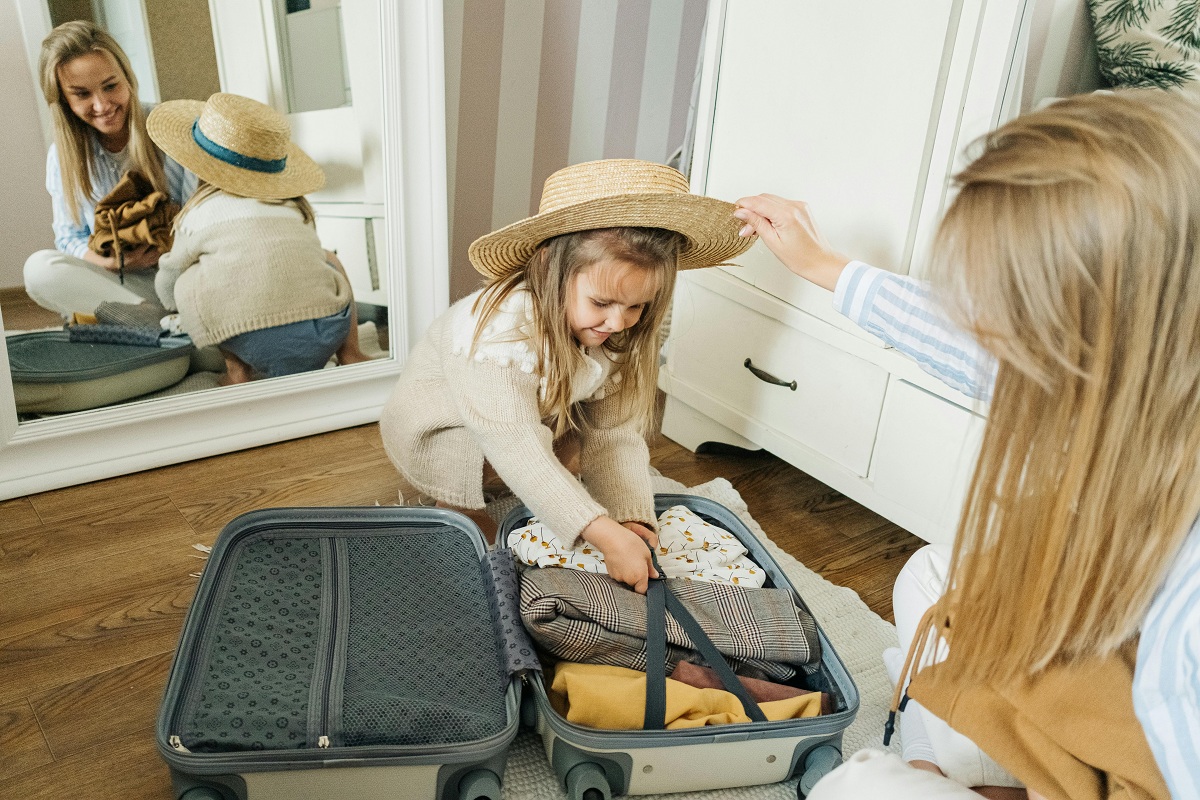
Packing for children is an exercise in thoughtful anticipation rather than excess. It is less about volume and more about emotional preparedness, ensuring that familiarity and comfort can travel alongside change.
For very young children, especially under the age of three, continuity is essential. Familiar snacks and basic foods provide a sense of stability in unfamiliar environments. Items related to sleep, such as a favourite toy or comfort object, help preserve the emotional architecture of rest. Even small details like a portable night light can transform an unfamiliar room into a manageable space. A carefully considered medical kit is also indispensable, including basic fever relief, antiseptic care, plasters, nasal support and remedies for insect bites, all of which provide reassurance in moments of uncertainty.
For children between three and ten, involvement becomes part of preparation. A small personal backpack gives them a sense of responsibility and participation. It is not simply storage but symbolic ownership of their journey. Snacks remain essential, particularly during transit, where timing can become unpredictable. Entertainment such as headphones, downloaded films or audiobooks helps structure long waiting periods without tension. Creative tools like sketchbooks and pencils allow expression without dependency on external stimulation.
For all family members, certain essentials exist beyond age. Travel insurance provides security in the background of every decision. Digital copies of important documents ensure continuity in case of loss. A simple list of emergency contacts creates quiet reassurance that support is always accessible, even when far from home.
How to handle challenges on the road
Travel with children is rarely linear. It contains moments of unexpected intensity that require flexibility rather than control. Long flights, for example, are best approached not as a single endurance test, but as a sequence of small emotional chapters. Changing activities at regular intervals, introducing new and unfamiliar distractions, and allowing screen time without guilt can transform the experience from resistance to adaptability. During takeoff and landing, simple solutions such as chewing snacks can ease physical discomfort related to pressure changes.
Emotional outbursts, often described as meltdowns, are not signs of failure but expressions of overload. Children experience disrupted sleep, unfamiliar environments and constant sensory input. In many cases, simple physiological needs such as hunger or rest are at the root of emotional escalation. Regular pauses for food, water and movement often restore balance more effectively than any attempt at strict behavioral control.
Illness while travelling is another inevitable possibility, and preparation reduces anxiety significantly. Knowing in advance where the nearest medical assistance is located and having valid insurance coverage creates a sense of readiness that allows parents to respond calmly rather than react under pressure. Most common childhood illnesses, when properly managed, resolve within a short period and rarely define the overall experience of the trip.
How to make the trip enjoyable for everyone, including the parents
One of the most important yet often overlooked aspects of family travel is the preservation of adult experience within the journey. Parenthood does not erase the need for rest, pleasure or shared moments of intimacy between adults. When children are asleep, the day does not end. It simply changes form. Evening can become a quiet continuation of travel, whether through a meaningful conversation, a shared meal or a slow walk that belongs only to adults.
It is also essential to release the pressure of perfection. Travel with children is not a curated aesthetic project. It is a living experience. Clothes may become stained, schedules may dissolve, meals may not resemble intention. Yet within this imperfection lies something deeply real. The memory of travel is rarely built from polished moments, but from lived ones.
Finally, there is immense value in noticing the small details. Children naturally observe what adults overlook. Their attention moves toward textures, sounds, colours and coincidences that escape structured perception. Recording these moments, not for performance but for memory, transforms travel into something richer. It becomes not only a journey through places, but a shared evolution of attention itself.


